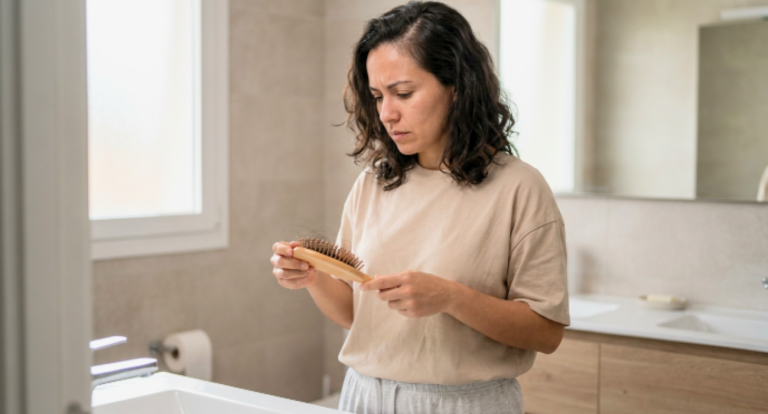
You pull hair from your brush and stop for a second.
That seems like a lot.
Then you notice more strands in the shower drain. Your ponytail feels thinner. Your scalp shows more near your part line.
Hair loss can feel scary. Many women first blame stress, hormones, or hair products.
But sometimes the real cause starts deeper inside the body.
Your thyroid could be involved.
The thyroid is a small gland in the front of your neck. It controls energy, metabolism, and how fast your cells work.
When thyroid hormone levels become too low or too high, the normal hair growth cycle can get disrupted. This can lead to noticeable shedding across the scalp.
Thyroid disease is one of the most overlooked causes of hair loss in women. In some cases, hair thinning starts months before other thyroid symptoms appear.
Table of Contents
ToggleHow Does Thyroid Affects Hair Growth?
Your hair is always moving through a natural growth cycle.
There are three main stages:
| Stage | What Happens |
|---|---|
| Anagen | Hair grows |
| Catagen | Hair slows down briefly |
| Telogen | Hair rests and falls out |
Most hairs stay in the growth phase for years before shedding.
Thyroid hormones help hair follicles produce energy and stay in the active growth phase.
When thyroid hormones change too much, more hairs move into the resting phase at the same time. That causes extra shedding.
Doctors call this type of hair loss telogen effluvium.
Instead of losing a few strands here and there, you may suddenly notice hair everywhere:
- On your pillow
- In the shower
- On your clothes
- Inside your hairbrush
This type of hair loss is usually spread across the entire scalp instead of one small area.
Hypothyroidism and Hair Loss
Hypothyroidism means the thyroid is underactive.
This is one of the biggest thyroid-related causes of hair loss in women.
When thyroid hormone levels drop:
- Hair grows more slowly
- Hair follicles stay in the resting phase longer
- More strands fall out
- New hairs take longer to grow back
Women with hypothyroidism often had more severe hair shedding than women with healthy thyroid levels.
The texture of the hair may also change.
Many women notice their hair becomes:
- Dry
- Rough
- Brittle
- Dull
Some women also lose hair from the outer edges of their eyebrows, which is a common sign of hypothyroidism.
Hyperthyroidism Can Cause Hair Loss Too
Hair thinning is not only linked with low thyroid hormone levels.
Hyperthyroidism, which means the thyroid is overactive, can also trigger shedding.
With hyperthyroidism, the body produces too much thyroid hormone. This can overstimulate hair follicles and stress the cells inside them.
Women with hyperthyroidism may notice:
- Fast shedding
- Very soft or fine hair
- Hair breakage
- Thinning across the scalp
Unlike hypothyroidism, where hair often feels coarse and dry, hyperthyroid hair may feel silky and extremely soft.
Hashimoto’s Disease and Hair Thinning
One common cause of hypothyroidism is Hashimoto’s thyroiditis.
This is an autoimmune disease. That means the immune system attacks the thyroid by mistake.
As the thyroid becomes damaged, hormone levels start to fall.
At the same time, inflammation from the immune system can also affect hair follicles directly.
This creates two problems at once:
- Hormone imbalance
- Inflammation around the follicles
That is one reason hair loss can become more severe in women with Hashimoto’s disease.
Research has also found links between autoimmune thyroid disease and alopecia areata, a condition that causes patchy hair loss.
Signs Your Hair Loss Could Be Thyroid-Related
Hair loss has many causes, so it helps to look for other symptoms happening at the same time.
Your thyroid may be involved if you also notice:
- Fatigue
- Weight changes
- Feeling cold often
- Dry skin
- Brain fog
- Depression
- Heavy periods
- Constipation
Thyroid hormones directly control hair follicle stem cells and the timing of hair growth cycles.
That is why thyroid problems can change both the amount and texture of your hair.
Thyroid-related hair loss is usually:
- Slow and gradual
- Spread across the scalp
- Paired with texture changes
- Linked with other body symptoms
It usually does not cause bald patches or a receding hairline.
The Iron Connection Most Women Miss
One important reason thyroid hair loss can get worse is low iron.
Your body needs iron to make healthy hair.
More specifically, it needs something called ferritin, which is the stored form of iron.
Low ferritin levels are very common in women with thyroid problems.
When ferritin drops too low:
- Hair follicles do not get enough oxygen
- Hair growth slows down
- Shedding increases
- New hair struggles to grow
Many women are told their iron levels look “normal,” but ferritin is not always checked during standard blood work.
That is why some women continue losing hair even after improving their thyroid hormone levels.
If you have thyroid-related hair loss, ask your doctor about checking ferritin too.
Nutrients That Support Hair and Thyroid Health
Your hair follicles are very active. They need nutrients constantly to grow healthy strands.
When certain vitamins or minerals are low, hair shedding may become worse.
Selenium
Selenium helps the body activate thyroid hormones properly.
Low selenium levels may affect:
- Thyroid function
- Hair growth
- Immune system balance
Brazil nuts are one of the richest natural sources of selenium.
Zinc
Zinc supports hair follicle repair and healthy hair growth.
Low zinc levels may lead to:
- Hair shedding
- Weak hair strands
- Slower regrowth
Women with thyroid disease sometimes have lower zinc levels than expected.
Vitamin D
A growing amount of research links low vitamin D levels with autoimmune thyroid disease.
Vitamin D also affects hair follicles directly.
Low levels may increase:
- Hair thinning
- Hair shedding
- Slow regrowth
Many women with Hashimoto’s disease also have vitamin D deficiency.
Can Thyroid Hair Loss Grow Back?
This is usually the biggest question women ask.
In many cases, yes.
Hair often grows back after thyroid hormone levels improve.
But it takes time.
Hair follicles work slowly. Even after treatment starts, it can take several months before shedding slows down.
Thyroid-related hair loss often improves once the thyroid condition is treated correctly.
Most women begin noticing:
- Less shedding after a few months
- Small regrowth around the hairline
- Fuller ponytails over time
- Improved texture
Full regrowth may take:
- 6 to 12 months
- Sometimes longer in severe cases
Patience is important because hair grows slowly.
What Tests Should You Ask For?
If you think your thyroid could be affecting your hair, blood tests can help find answers.
Doctors often start with:
- TSH
Checks how hard the body is working to stimulate the thyroid - Free T4
Measures thyroid hormone levels - Free T3
Shows active thyroid hormone levels - Thyroid antibodies
Helps check for Hashimoto’s disease
You may also want to ask about:
- Ferritin
- Vitamin D
- Zinc
- Iron studies
Thyroid blood tests are the best way to diagnose thyroid disease.
Biotin Can Affect Thyroid Test Results
Many hair supplements contain biotin.
Biotin is often marketed for stronger hair and nails.
But there is one problem.
High doses of biotin can interfere with thyroid blood tests.
This can lead to inaccurate results.
If you take biotin supplements, doctors may ask you to stop them for a few days before thyroid testing.
When Should You See a Doctor?
Hair shedding becomes concerning when it:
- Lasts for months
- Gets worse over time
- Happens with other body symptoms
- Causes visible thinning
You should especially speak with a doctor if you also have:
- Fatigue
- Weight changes
- Dry skin
- Feeling cold often
- Brain fog
- Depression
- Irregular periods
Many women spend months trying new shampoos or hair products when the real issue starts inside the body.
A thyroid problem will not improve with hair products alone.
Final Thoughts
Hair loss can feel emotional and frustrating.
For many women, it affects confidence, stress levels, and daily life.
But if your hair has been thinning and you cannot figure out why, you should check on your thyroid.
Thyroid disease is one of the most overlooked causes of hair loss in women. In some cases, shedding starts long before other symptoms become obvious.
That is why it helps to pay attention to changes happening across your body, not just your hair.
If you notice:
- Hair shedding
- Fatigue
- Dry skin
- Weight changes
- Brain fog
- Feeling cold often
your thyroid could be involved.
The good news is that thyroid-related hair loss is often treatable.
Once the underlying thyroid problem is diagnosed and managed, many women slowly begin seeing healthier hair growth again.
FAQs
Can thyroid problems really cause hair loss?
Yes. Both hypothyroidism and hyperthyroidism can disrupt the normal hair growth cycle and lead to noticeable shedding.
What does thyroid hair loss look like?
Thyroid hair loss is usually spread across the whole scalp instead of one small area. Many women notice a wider part line, more shedding, and thinner ponytails.
Does hypothyroidism cause eyebrow hair loss?
Yes. Losing hair from the outer edges of the eyebrows is a common sign of hypothyroidism.
How long does thyroid hair loss last?
Hair shedding may continue for several months after starting treatment because hair grows slowly. Many women begin noticing improvement within 3 to 6 months.
Can hair grow back after thyroid treatment?
In many cases, yes. Treating the thyroid condition often helps reduce shedding and improve regrowth over time.
What thyroid tests should women ask for?
Doctors commonly check:
- TSH
- Free T4
- Free T3
- Thyroid antibodies
Ferritin and vitamin D testing may also help identify other causes of hair thinning.
Healthy Avid provides educational health content designed to help women better understand their bodies. This article is for informational purposes only and does not replace personalized medical advice. Always speak with a qualified healthcare provider about hair loss, thyroid symptoms, and testing.
Written by Lauretta Iyamu, PharmD — Medical Writer and Clinical Researcher focused on women’s health, brain health and evidence-based wellness communication.
Sources
Healthy Avid uses only high-quality sources, including peer-reviewed studies, to support the facts within our articles. Read our editorial process to learn more about how we fact-check and keep our content accurate, reliable, and trustworthy.
- Hussein RS, Atia T, Bin Dayel S. Impact of thyroid dysfunction on hair disorders. Cureus. 2023;15(8):e43266. doi:10.7759/cureus.43266
- Almutairi N, Eisa AA, Almutairi AK, et al. Is thyroid dysfunction a common cause of telogen effluvium? A retrospective study. Int J Dermatol. 2024;63(4):512–517. doi:10.1111/ijd.16906
- Charles Medical Group. Hair loss thyroid connection: the diagnostic sequencing framework. May 2026.
- Vidali S, Knuever J, Lerchner J, et al. Hypothalamic-pituitary-thyroid axis hormones stimulate mitochondrial function and biogenesis in human hair follicles. J Invest Dermatol. 2014;134(1):33–42. doi:10.1038/jid.2013.286
- Dong TR, Li YJ, Jin SY, et al. Thyroid hormone and hair growth. Stem Cell Res Ther. 2025;16(1):44. doi:10.1186/s13287-025-04182-z
- Assure Clinic. Thyroid hair loss: 6 signs you should never ignore. April 2026.
- Medical News Today. Thyroid and hair loss: symptoms, treatment, and outlook. Updated November 2024.
- Avant Medical Group. Thyroid disorders and hair loss. November 2025.
- Trüeb RM. Serum biotin levels in women complaining of hair loss. Int J Trichology. 2016;8(2):73–77. doi:10.4103/0974-7753.188040